
Fiber laser welding is a method of joining metals in which a laser beam with a wavelength of about 1070 nm is focused on the joint line, melts the metal in a very small spot, and, as the beam moves, produces a continuous or spot weld seam. Its main advantage is the high concentration of energy: low heat input, a narrow heat-affected zone (HAZ), less distortion, and the potential for high speed.
But “laser” on its own does not make a good weld. The quality of the result depends on the material and thickness, joint design and fit-up accuracy, beam quality, spot diameter, focus, shielding gas, filler wire, surface cleanliness and process control. This article is written for production engineers, workshop managers and industrial buyers; instead of presenting a machine, it explains the decision logic: when a laser is the right choice, when it is not, and how to prove this with a real test before buying.
Short answer for those in a hurry
- Laser welding is most valuable when production volume, part precision, seam appearance or distortion control matters and the joint is controllable in terms of assembly accuracy.
- Rated power (watts) is not the only criterion; beam quality and spot diameter determine what power density actually reaches the part.
- Most defects (porosity, spatter, undercut) come from molten-pool instability and poor preparation, not simply from a lack of power.
- Aluminum, copper, galvanized sheet and dissimilar-metal joints are weldable but more difficult, and the purchase should not be finalized without sample trials.
- Laser safety (Class 4) and weld fume are an inseparable part of the cost and of workshop design.
- Judge the real cost by “cost per good part,” not by the price of the machine.
For practical settings of a handheld machine (nozzle, focus, wobble, gas), see the user guide to handheld fiber laser welding machines and for pre-purchase questions, see the frequently asked questions before buying a fiber laser welding machine. This article is the theoretical and decision-making foundation for both.
Table of Contents
- What is fiber laser welding?
- Process physics: conduction mode and keyhole
- Why watts alone are not enough: beam quality and power density
- Machine types
- Machine components
- Weldability of metals
- Joint design, gap and fixturing
- Process parameters and the right way to set them
- Shielding gas, filler wire and surface preparation
- Weld defects and root causes
- Quality control, inspection and process monitoring
- Comparison with TIG, MIG/MAG and resistance welding
- When is laser welding not the right choice?
- Safety
- Cost of ownership and cost per good part
- Sample trial: what to send and what to ask for
- Purchase checklist
- Frequently asked questions
- Conclusion
- References
What is fiber laser welding?
In laser welding, the optical energy absorbed at the metal surface is converted to heat. When the energy density is sufficient, the metal at the joint melts; after the beam passes, the molten pool solidifies and the joint forms.
In a fiber laser, the beam is generated in an active fiber medium (ytterbium-doped fiber) and is delivered through a flexible optical fiber to the welding head. This design has three practical consequences: delivering the beam to a handheld or robotic head is simple, the beam quality is high, and a wavelength of about 1070 to 1080 nm is absorbed reasonably well by most industrial metals for welding.
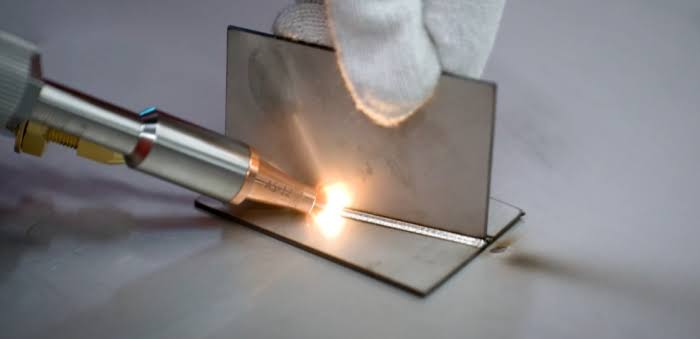
Handheld fiber laser welding on a T-joint
Key difference from arc welding
In TIG and MIG/MAG the heat source is an electric arc; the arc is relatively wide and transfers a lot of heat to the part. In a laser, energy is concentrated in a much smaller spot. The result is a narrower, deeper weld, lower total heat and higher speed under the right conditions; but in return the process becomes more sensitive to assembly accuracy, gap and beam alignment.
Process physics: conduction mode and keyhole
Understanding the two main modes of laser welding is the basis for diagnosing many defects.
Heat-conduction mode (Conduction)
When the power density is lower, the metal melts only from the surface and heat travels to depth by conduction. The pool is wide and shallow, stable, and has less spatter and porosity; it suits thin sheets and delicate seams where appearance matters. Penetration depth is limited.
Deep-penetration mode (Keyhole)
When the power density rises above a threshold, the metal under the beam is not only melted but locally vaporized. The vapor pressure of the metal opens a narrow, deep cavity (the keyhole) in the molten pool. The beam is reflected several times inside this cavity and absorbs energy far more effectively; this is why a deep, narrow weld with a high depth-to-width ratio becomes possible.
Keyhole stability: the origin of many defects
The keyhole is a dynamic cavity, not a fixed shape. The balance between vapor pressure (which keeps the cavity open) and surface tension and hydrodynamic pressure of the melt (which tend to close it) is constantly fluctuating. When this balance is upset:
- the bottom or wall of the cavity becomes unstable and may collapse; a vapor or gas bubble is trapped in the melt and does not escape before solidification → porosity;
- molten metal is ejected outward → spatter;
- molten metal shifts toward the back of the weld and is cut off → discontinuity and undercut.
An important point for buyers and operators: increasing power only makes the cavity deeper and less stable. Sometimes the defect comes not from a shortage but from an excess or instability of energy. The remedy is usually to adjust speed, focus, beam oscillation and gas together, not merely to turn the power up and down.
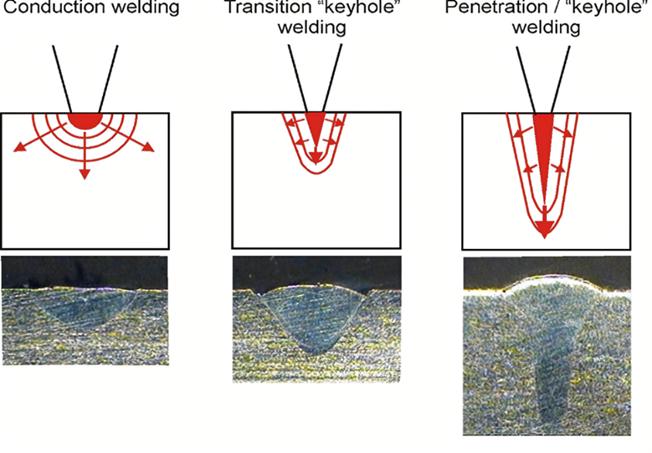
Comparison of conduction (left), transition (center) and deep-penetration keyhole (right) welding; a macro cross-section of the weld is shown under each mode
Why watts alone are not enough: beam quality and power density
Two machines with the same rated power can produce completely different results. The reason is the power density at the part:
Spot area varies with the square of its diameter, so reducing the spot diameter has a strong effect.
Illustrative example (the numbers show the concept; they are not the specifications of any particular machine):
| Condition | Spot diameter | Approximate power density at 2 kW power |
|---|---|---|
| Small spot | 0.2 mm | about 6.4 MW per square centimeter |
| Larger spot | 0.6 mm | about 0.7 MW per square centimeter (nine times lower) |
With the same 2 kW, the smaller spot can easily enter keyhole mode while the larger spot may remain in conduction mode. The keyhole power density is usually described as on the order of several hundred thousand to one million watts per square centimeter or more, and it depends on the material and conditions.
Factors affecting spot diameter and quality
- Beam quality (e.g., BPP or M²): A beam with better quality can be focused to a smaller spot or with better depth of field.
- Delivery fiber diameter: A thinner fiber usually gives a smaller spot and higher density, but sensitivity to gap tolerance increases; a thicker fiber gives better gap tolerance and a wider weld.
- Head optics (focal length and collimator): The ratio of focal length to collimator determines the final spot size.
- Focus position: The focal point on the surface, below the surface or above it changes the shape and depth of the weld.
Line energy (Line Energy)
To compare different conditions, it is useful to look at the energy input per unit length of weld:
For example, 2000 W at a speed of 20 mm/s equals 100 joules per millimeter. Part of this energy is not absorbed because of reflection. If we double both the speed and the power, the line energy stays constant but the power density and the pool shape change; so “the same line energy” does not mean “the same weld.”
Takeaway for purchasing: in addition to power, ask the vendor for the beam quality, fiber diameter, head optics specifications and the spot diameter at focus.
Machine types
By beam generation mode
- Continuous wave (CW): Energy is delivered continuously; it is the most common mode for long seams and sheet-metal work.
- Pulsed / modulated: Energy is delivered in pulses with a defined duration, energy and frequency; useful for small parts, heat-sensitive joints and spot welding. Its effect depends on pulse energy, pulse duration, frequency and spot overlap; being “pulsed” does not in itself mean being suitable for every delicate part.
By how the head is guided
- Handheld: Flexible for workshops with a variety of parts; quality and speed depend on operator skill and fixturing.
- Semi-automatic and CNC: The head is mounted on a motion axis; path and speed are more consistent.
- Robotic and production line: For high volume and repeatability; requires precise fixturing, seam tracking and a quality-control system.
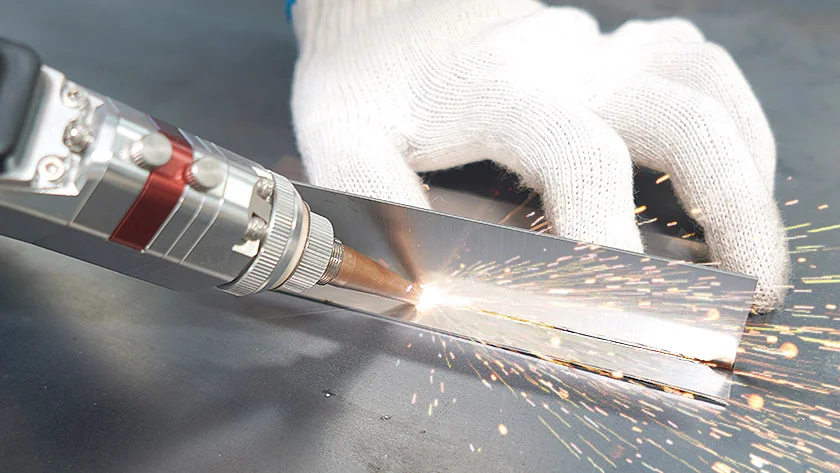
Handheld machine
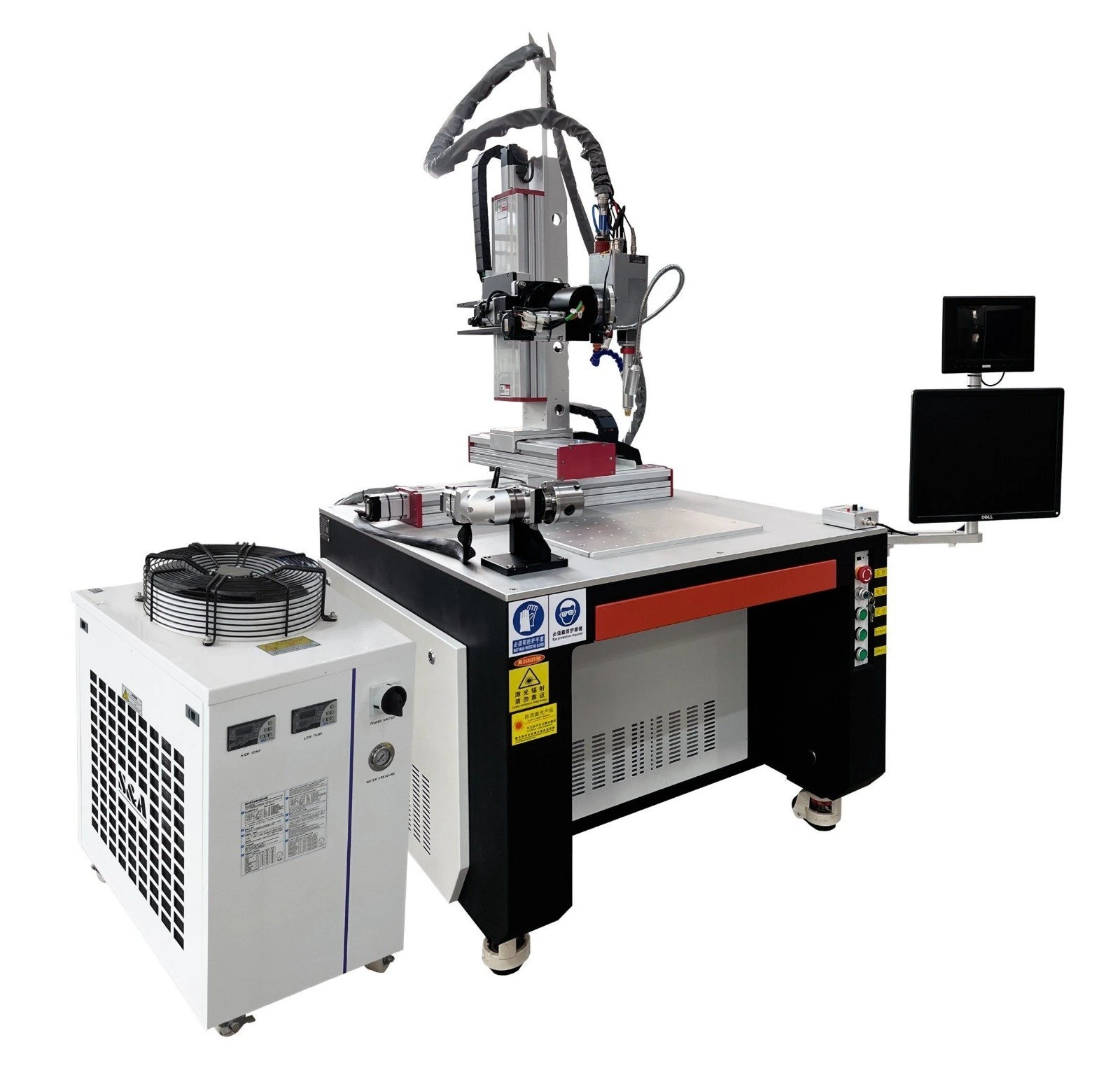
CNC machine with worktable and water-cooled chiller
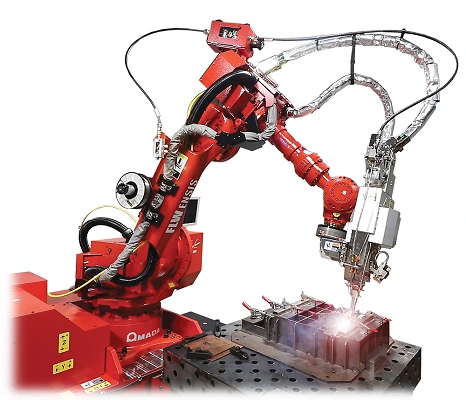
Robotic system
For examples of Asim Electronic water-cooled machines (in 1.5, 2 and 3 kW power ratings), see the water-cooled laser welding machine.
Machine components
| Component | Role | Selection note |
|---|---|---|
| Fiber laser source | Beam generation | Power, power stability, beam quality, brand and access to service |
| Delivery fiber | Delivers the beam to the head | Fiber diameter, length, sensitivity to bending and to contamination of the fiber end |
| Welding head | Collimator, focus, beam oscillation, nozzle, wire and gas inlet | Focal length, wobble capability, protective lens, nozzle design |
| Controller | Sets power, speed, pattern and safety | Parameter storage, access lock, data logging capability |
| Cooling system | Temperature stability of the source and head | Chiller capacity, water temperature, water quality; for example, the laser welding chiller WFL and chiller WFL-3000 |
| Wire feeder | Adds filler metal | Wire diameter, feed stability, compatibility with the nozzle |
| Shielding gas | Reduces oxidation and stabilizes the pool | Purity, regulator, flow rate, gas path |
| Safety equipment | Enclosure, interlock, eyewear, fume extraction | Per the risk assessment |
| Fixture and table | Holds the part in alignment | Accuracy, no excessive heating, access to the seam |
When buying, also check the availability of head consumables (protective lens, nozzle); the guide to selecting lenses and consumable parts for fiber laser heads is useful for this.
Weldability of metals
| Material | Main challenge | Practical note |
|---|---|---|
| Carbon steel | Good absorption; controlling penetration and hardness in high-carbon steels | Surface cleanliness; in high-carbon alloys, check the risk of hardening and cracking |
| Stainless steel | Heat tint and oxidation; weld root | Proper gas shielding, heat-input management; austenitic stainless steel usually has good weldability |
| Aluminum | High reflectivity, high thermal conductivity, oxide layer, porosity (especially hydrogen), solidification cracking in some series | Careful cleaning; choose a suitable wire (in some alloys, aluminum–silicon wire); keyhole stability is critical |
| Copper and its alloys | Very high reflectivity and high thermal conductivity; starting and stabilizing the weld is difficult | At a wavelength of 1 micron the initial absorption is low; for precision copper applications (such as batteries), green or blue lasers are also considered; a sample trial is mandatory |
| Galvanized sheet | Zinc vaporizes (boiling point about 907 degrees Celsius) below the melting point of steel; spatter and porosity | In a lap joint, providing a path for zinc vapor to escape (a controlled gap) and fume extraction are important |
| Titanium | Strong reactivity with oxygen and nitrogen at high temperature | Gas shielding is required on the back side and at the backing, and after welding until the temperature has dropped |
| Dissimilar metals | Brittle intermetallic compounds (e.g., copper–aluminum), cracking and expansion mismatch | Only on the basis of testing the mechanical and electrical properties of the joint; never guarantee it without testing |
Note: The table above is a risk guide. For each specific alloy, sample welds should be made on real sheets, followed by macro sectioning and mechanical testing.
Joint design, gap and fixturing
Compared with arc welding, laser welding is more sensitive to joint geometry. The reason is the small spot: if the seam runs under the spot and there is a gap, the beam may pass through the gap without sufficient melting.
Most common joints
- Butt joint: Requires clean edges, accurate cutting and a very small gap; the best appearance but the highest sensitivity.
- Lap joint (Lap): More tolerant of positioning; for galvanized sheet it requires gap control so that zinc vapor can escape.
- Corner and T: Usually with filler wire and wobble to bridge the gap and provide strength.
Key measures
- Match the cutting and bending tolerance of parts with the allowable gap tolerance; if parts are produced by plasma or poor-quality cutting, the edges should be corrected before welding.
- Use beam oscillation (Wobble) and Filler wire to increase gap tolerance; but these are not a substitute for fixturing and assembly accuracy.
- For repeat production, design a clamp-type fixture with suitable heat resistance and no magnetic effect on the beam and fume.
- The seam path and the distance from the head to the part must stay constant along the weld; in serial production, a seam tracker (Seam Tracking) compensates for position error.
Process parameters and the right way to set them
| Parameter | Effect of increasing | Risk of excess |
|---|---|---|
| Power | Greater penetration and possible speed | Burn-through, spatter, keyhole instability, perforation |
| Speed | Lower heat input and distortion | Insufficient penetration, discontinuous seam |
| Spot diameter / beam quality | Larger spot = lower density, greater gap tolerance | Shifting from keyhole to conduction mode |
| Focus position | Changes weld depth and shape | Low penetration or wasted energy |
| Beam oscillation (width/frequency) | Wider weld, better gap tolerance, more stable pool | Reduced depth, extra heat |
| Gas: type, flow rate, angle | Less oxide and heat tint | Flow turbulence and contamination; excessive flow causes spatter and pool agitation |
| Wire: type and feed speed | Fills the gap, changes the chemical composition | Shortage or excess of wire, incomplete melting |
Recommended method to reach a stable parameter set
- Write down the material, the thickness of both parts, the joint type and the acceptance criteria (penetration, width, appearance).
- Select the nozzle, gas and wire to suit the joint.
- Set focus and power from the manufacturer’s recommended starting point.
- Change only one variable per test, and record the result.
- Take a macro section from each condition; the appearance of the seam alone is not an indication of penetration and of the internal soundness of the weld.
- Define the stable window (Process Window): the range of power, speed and focus within which quality is acceptable. The wider the window, the more reliable the process.
- Record the final parameters in the welding procedure specification (WPS) and validate them for every change of material or thickness.
The practical starting values for a handheld machine are given in the user guide to handheld laser welding machines. A generic power–thickness table, without stating the machine conditions, joint and target penetration, is misleading and has deliberately not been provided in this article.
Shielding gas, filler wire and surface preparation
Shielding gas
- Argon: The most common general-purpose gas; inert and more economical than helium.
- Helium or helium mixtures: In some applications it reduces the metal plasma above the pool and improves penetration, but it is more expensive.
- Nitrogen: Used in some applications (such as some stainless steels); the effect of nitrogen on the alloy must be checked.
- Mixtures (e.g., argon with an additive): For specific applications; select based on the material and the manufacturer’s recommendation.
Note: besides oxidation, gas also changes the behavior of the pool. Check the purity, leaks in the path, flow rate and the direction of gas exit; a large part of “porosity and heat tint” comes from the gas path, not from the machine.
Filler wire
Wire is used to fill the gap, correct the chemical composition of the weld and increase crack resistance. The wire material must be compatible with the base metal (e.g., in aluminum alloys prone to solidification cracking). The wire must be dry and clean; moisture and oil on the wire surface are a source of hydrogen and porosity.
Surface preparation
- Remove oil, grease, paint, rust and thick oxide; on aluminum, control the oxide layer by mechanical or chemical means and keep the time between cleaning and welding short.
- Cut edges (e.g., oxygen laser cutting) may have an oxide layer and lead to porosity; clean the edge or choose nitrogen cutting.
- For painted or coated sheets, the coating should be removed at the weld location, or the process should be validated for it.
Weld defects and root causes
| Defect | Probable causes | Checks and corrective action |
|---|---|---|
| Lack of penetration / incomplete fusion | Low power or energy density; high speed; improper focus; large gap | Check focus and spot diameter; reduce speed; control the gap; macro section |
| porosity | Keyhole instability or collapse; surface contamination; moisture in wire and gas; zinc vapor in galvanized sheet; hydrogen in aluminum | Cleaning; dry wire; review the gas; adjust wobble and speed; vapor-escape gap in galvanized sheet |
| Solidification cracking | Susceptible chemical composition; high stress; rapid cooling; high depth-to-width ratio | Change the wire; correct the weld geometry; preheat or reduce stress; check the metallurgy |
| Cold cracking / embrittlement | Hardenable steels; hydrogen; rapid cooling | Control hardness; preheat; postheat |
| spatter | Pool instability; contamination; coating vapor; high power with low speed | Check cleanliness; adjust power and speed; adjust wobble; effective extraction |
| Undercut | High speed; unsuitable energy; too little wire | Reduce speed or increase wire; adjust focus |
| Burn-through and perforation | Heat input above what is needed; low speed; large gap | Reduce power; increase speed; check the fixture |
| Heat tint and oxidation | Insufficient gas shielding; air in the gas path; excess heat | Increase gas coverage; control leaks; post-weld cleaning |
| Irregular weld width | Unstable hand movement; gap variation; wire instability | Improve fixturing; seam tracking; stabilize travel speed |
| Cracking or fracture in aluminum and copper | Dissimilar joint; intermetallic compounds | Change the design; interlayer; strength testing |
Root-cause analysis method (Root Cause)
- Classify the defect by type (e.g., porosity: spherical, tubular or surface).
- Section the part; the shape and location of the defect often reveal the origin (porosity at the root is usually keyhole instability; scattered porosity is usually contamination and gas).
- Change only one variable and repeat.
- Record the result and the parameters to avoid repeating inconclusive tests.
For practical troubleshooting of a handheld machine, also use the table in the user guide.
Quality control, inspection and process monitoring
“It looks like a good weld” is not an acceptance criterion, especially for safety-critical joints.
Relevant standards (for reference; check the current edition)
- ISO 13919-1 and ISO 13919-2: Quality levels for imperfections in laser and electron beam welds (for steel and aluminum, respectively).
- ISO 15609-4: Preparation of the welding procedure specification (WPS) for laser beam welding.
- ISO 15614-11: Qualification of the welding procedure for laser and electron beam welding.
- ISO/TR 17671-6: Guidance on recommendations for laser beam welding (technical report; the publication date is older, and for contractual requirements the current standards must be checked).
Inspection methods
| Method | What it measures | Application |
|---|---|---|
| Visual inspection | Seam shape, discontinuities, spatter, color | All parts; not sufficient |
| Macro and micro sectioning | Penetration, width, internal porosity, heat-affected zone | Process validation and sampling |
| Mechanical testing (tensile, bending, shear) | Actual joint strength | Process qualification and safety-critical parts |
| Liquid penetrant and magnetic particle | Surface cracks | Sensitive parts |
| Radiography and ultrasonic | Porosity and internal defects | Critical parts |
| Hardness testing | Hardening in the HAZ | Hardenable steels |
Process monitoring in serial production
On a production line, instead of discovering defects after production, the process can be monitored in real time:
- Seam tracking: correcting the beam position relative to the seam;
- Optical sensors and photodiodes: monitoring the radiation emitted from the pool to detect changes in conditions;
- Penetration depth measurement (e.g., by optical interferometry methods): for some advanced applications;
- Per-part data recording (Traceability): especially in the automotive industry and sensitive equipment.
For the production manager, this section is the boundary between a “welding machine” and a “reliable welding process.”
Comparison with TIG, MIG/MAG and resistance welding
| Criterion | Fiber laser | TIG | MIG/MAG | Resistance spot welding (AC / MFDC) |
|---|---|---|---|---|
| Energy source | Laser beam | Arc | Arc | Resistive heat + pressure |
| Heat input and distortion | Usually low | Medium | Medium to high | Localized and low |
| Speed | High in a suitable application | Low | Medium to high | Very fast at each spot |
| Gap tolerance | Low (improved somewhat with wire and wobble) | High | High | Medium, depends on sheet contact |
| Filler wire | Optional | Optional | Consumable | None |
| Seam type | Continuous or spot | Continuous | Continuous | Spot only or seam (roller) welding |
| Seam appearance | Usually clean and narrow | Clean but skill-dependent | Needs more finishing | Electrode marks; no continuous seam |
| Skill dependence | Medium (handheld); low (automatic) | High | Medium | Low |
| Initial investment | High | Low | Low to medium | Medium to high |
| Special safety | Class 4 laser | Arc radiation | Arc radiation | Sparks and spatter |
Relationship with resistance welding: MFDC
If your product involves overlapped sheets with spot joints and high volume (e.g., body parts or sheet-metal work), resistance welding, especially MFDC may be very competitive in terms of cost per joint and speed. By contrast, if you need a continuous seam, access from one side, a clean appearance or a butt joint, the laser has the advantage. To learn about this option, see the resistance welding machines (MFDC), resistance welding machine (MFDC) by Asim Electronic and guide to selecting power cable, chiller and compressor for press welders, types AC and MFDC.
When is laser welding not the right choice?
The most honest section of a buying guide is this:
- Parts with a poor gap and tolerance: If you cannot control fixturing and assembly accuracy, the cost of rework eats the benefit of the laser.
- Very low volume with highly varied and thick parts: High variety and deep penetration in large thicknesses may be cheaper with arc processes.
- Lap and spot joints at high volume: Resistance welding is often more cost-effective.
- Copper and aluminum without testing and support: The risk of porosity, cracking and instability is high; do not buy without a sample trial.
- A workshop that cannot implement laser safety requirements: Enclosure, training, ventilation and risk assessment are mandatory.
- Parts that require a specific customer standard or full traceability: Without monitoring and documentation, the process is not acceptable.
Safety
Beam hazard
Industrial fiber laser welding machines are usually in laser Class 4 (classification per IEC 60825-1). The beam, at about 1070 to 1080 nm, is invisible (near-infrared); the absence of visible light does not mean the absence of hazard. The direct, scattered and reflected beam from metal surfaces can damage eyes and skin.
Essential measures
- Risk assessment and determination of the nominal hazard zone;
- Enclosure, curtain or guard and interlock per safe design; for handheld machines, control of the work area and beam activation conditions;
- wavelength- and power-specific laser safety eyewear (with an appropriate protection rating); eyewear does not replace guards and interlocks (see the laser safety eyewear selection guide);
- Warning signs and a ban on entry by untrained persons;
- Operator training and preparation of work instructions;
- A laser safety officer in the workshop;
- Reference for laser machine safety: ISO 11553-1 and related standards.
For laser classification and the safety differences between laser types, see the differences between classes and types of laser machines and the comprehensive guide to the safety of CNC and laser machines.
Fumes and particulates
Welding fume, especially in stainless steel (chromium and nickel compounds), coated metals (zinc in galvanized sheet) and special alloys, is harmful to breathe. Local extraction near the weld and general ventilation are required; the filter type must be chosen to suit the material.
Cost of ownership and cost per good part
The price of the machine is only one part of the cost. Build the total cost of ownership (TCO) from these items:
- Purchase of the machine and ancillary equipment (chiller, gas, wire feeder, fixture);
- Safety (enclosure, eyewear, fume extraction) and site preparation (electricity, cooling);
- Electricity and gas consumption;
- Welding wire and consumable parts (protective lens, nozzle);
- Training and labor;
- Service, spare parts and downtime;
- Scrap and rework;
- Final finishing and quality inspection.
The right metric: cost per good part
This metric also accounts for the effect of scrap and rework. Laser welding is sometimes more expensive in capital but cheaper per good part (less finishing, distortion and scrap), and sometimes the reverse.
Hypothetical example (the figures are illustrative and unrealistic)
Assume that in the current process each part has a finished cost of 80,000 toman for welding and finishing and 10% of parts are reworked. If after adopting the laser the cost per part falls to 55,000 toman and rework to 3%, with 5,000 parts per month:
- Approximate monthly saving = (80,000 − 55,000) × 5,000 = 125 million toman;
- Simple payback = initial investment ÷ net monthly saving (after deducting service, gas, training and downtime).
This formula is approximate; for a serious decision, also take into account the effect of inflation, depreciation and actual capacity utilization. For a comparison with the current offer on the site, the frequently asked questions before buying a laser welding machine are also useful.
Sample trial: what to send and what to ask for
The most reliable way to decide is to test on your real part.
What to prepare for the trial
- 5 to 10 parts or sheets of the same material, thickness, coating and cutting conditions as real production;
- The joint drawing and the seam location;
- The worst real gap or tolerance on the production line (not the best case);
- Acceptance criteria: penetration, weld width, appearance, strength, leak-tightness (if required), color;
- Target speed and volume.
What to ask from the trial
- Photos of the seam and macro sections (at least one sample from each condition);
- Exact recorded parameters (power, speed, focus, gas, wire, wobble);
- Actual weld time per part;
- Mechanical test results (if needed);
- A demonstration of the stable window (several adjacent conditions that are all acceptable);
- Explicitly: what failed and why.
To arrange a trial and a technical review of your part, request a consultation through the Asim Electronic contact page.
Purchase checklist
- I have specified the material, thickness, joint type and actual gap of the parts.
- I have written down the acceptance criteria (penetration, appearance, strength).
- The volume and target cycle time are defined.
- The machine has been tested on my real part and I have a macro-section report.
- I have obtained the power, beam quality, fiber diameter, head optics and spot diameter from the vendor.
- I have checked the chiller specifications, input power and gas consumption.
- I have included safety (enclosure, eyewear, fume extraction, training) in the cost.
- Consumable parts, spare parts and service response time are defined.
- The warranty and its scope (laser source, head, fiber) are in writing.
- The machine acceptance criteria at delivery are stated in the contract.
- I have compared the alternatives (TIG, MIG/MAG, resistance MFDC) on the basis of cost per good part.
Frequently asked questions
What is fiber laser welding?
A method of joining metals using a focused laser beam with a wavelength of about 1070 nm, which melts the metal at the joint and produces the weld seam as the beam moves.
Is laser welding stronger than argon welding?
Neither is absolutely stronger. Strength depends on the material, penetration, absence of defects and joint design. The comparison should be made with samples under equal conditions and with mechanical testing.
Why does laser welding develop porosity?
Common causes: keyhole instability or collapse, contamination and moisture on the surface or wire, an insufficient or contaminated gas path, zinc vapor in galvanized sheet, and hydrogen in aluminum. Diagnosis is done by macro sectioning and changing variables one at a time.
What is a keyhole?
A narrow, deep cavity filled with metal vapor in the molten pool, formed at high power density, which makes deep penetration possible. Its stability is critical to weld quality.
Is more power always better?
No. More power may increase penetration but also brings spatter, burn-through and instability. Beam quality, spot diameter, speed and focus are equally important.
What power is needed for what thickness?
There is no single answer; it depends on the material, joint, gap, target speed and use of wire. Approximate values are given in the pre-purchase questions article, and they must be confirmed with a sample trial.
Can aluminum and copper be welded with a fiber laser?
Yes, but it is harder than steel: high reflectivity and thermal conductivity and the risk of porosity and cracking. For copper and dissimilar joints, do not buy without a sample trial.
Does laser welding need filler wire?
Not always. Many precise seams are welded without filler wire, but wire may be needed to fill the gap, change the weld chemistry or prevent cracking.
Does laser welding discolor stainless steel?
It may. The amount of heat tint depends on the heat input and gas shielding, and it is reduced by controlling the gas and parameters.
Which is better: laser welding or resistance welding (MFDC)?
For a continuous seam and clean appearance, the laser; for spot joining of overlapped sheets at high volume, resistance welding is often more economical. Decide on the basis of cost per good part.
What is the safety class of a fiber laser welding machine?
Usually Class 4. It requires a risk assessment, guarding, wavelength-specific eyewear, interlocks, training and fume extraction.
What should I test before buying?
A real part with the worst gap on the production line, with recorded parameters, macro sectioning and, if needed, mechanical testing.
How much does machine maintenance cost?
It depends on the brand, operating hours and environment; consumables (protective lens, nozzle), cooling, gas and service should be included in the annual cost.
Conclusion
Fiber laser welding is a powerful tool for fast, precise joining of metals, but its value emerges only under the right conditions: a controllable joint, a validated process, observed safety, and cost calculated on the basis of good parts. A sound decision goes through three steps:
- Write down the actual conditions of the part, joint and volume;
- Run a sample trial on that same part and see the stable process window;
- Compare the total cost of ownership and the cost per good part across the other options (TIG, MIG/MAG, resistance MFDC).
Need a technical review of your part? Prepare the material, thickness, joint type and volume, and submit a request for consultation and a sample trial via the Asim Electronic contact page. To get to know the machines, see the water-cooled laser welding machine.
References
- TWI — Laser Welding (a research and engineering reference for welding): advantages, limitations, thermal distortion and aluminum challenges.
- TRUMPF — Laser Welding and process monitoring systems: weld types, seam monitoring and process control.
- Review and Analysis of Modern Laser Beam Welding Processes (MDPI): parameters, keyhole stability and porosity.
- Research papers on keyhole geometry simulation and the effect of plasma properties (Frontiers) and on copper–aluminum laser welding for automotive batteries (green laser).
- ISO 13919-1/-2, ISO 15609-4, ISO 15614-11, ISO/TR 17671-6, IEC 60825-1, ISO 11553-1.